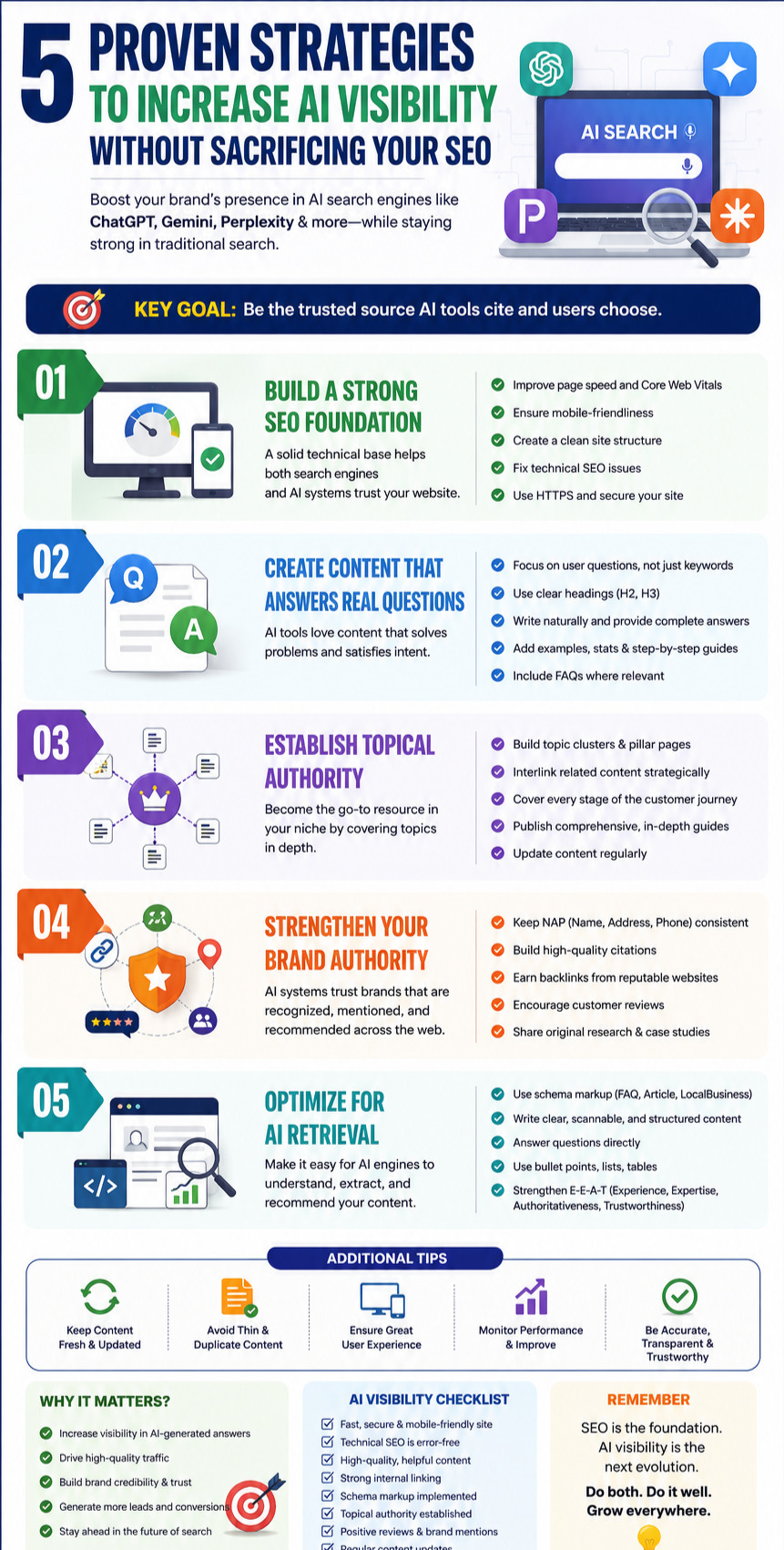
5 Proven Strategies to Increase AI Visibility Without Sacrificing Your SEO
Artificial intelligence is changing the way people search for information. Instead of typing keywords into Google alone, users are increasingly asking questions in AI-powered platforms like ChatGPT, Google AI Mode, Gemini, Claude, Microsoft Copilot, and Perplexity.
This shift doesn’t mean traditional SEO is dead. In fact, strong SEO has become more important than ever. AI systems often rely on authoritative, well-structured, and trustworthy websites when generating answers. If your website already follows SEO best practices, you’re in a better position to be discovered by both search engines and AI assistants.
At Aone Web Expert, we’ve seen businesses benefit from combining traditional SEO with newer strategies aimed at improving AI visibility. Rather than replacing SEO, AI optimization builds on the same principles: useful content, technical excellence, and a strong online reputation.
Why AI Visibility Matters
Search is no longer limited to blue links on a search engine results page. AI assistants summarize information, recommend businesses, answer questions, and help users make purchasing decisions without requiring them to visit multiple websites.
This creates a new opportunity for businesses. If AI tools frequently reference your website as a trusted source, you gain:
- Increased brand recognition
- Higher-quality traffic
- Greater credibility
- More qualified leads
- Stronger long-term online authority
The businesses that prepare today will have a competitive advantage as AI-powered search continues to grow.
Strategy 1: Build a Strong SEO Foundation First
Many website owners focus entirely on AI optimization while ignoring the basics. That’s a mistake.
AI systems generally prefer websites that are already trusted by search engines. If your technical SEO is weak, AI platforms are less likely to reference your content.
Start by ensuring your website has:
Fast Loading Pages
Users expect websites to load quickly. A slow website creates a poor user experience and can reduce search visibility.
Optimize:
- Images
- JavaScript
- CSS
- Server response times
- Caching
A faster website benefits both visitors and AI crawlers.
Mobile-Friendly Design
Most searches now happen on mobile devices.
Your website should:
- Display correctly on every screen size
- Load quickly on smartphones
- Have readable fonts
- Include easy navigation
- Avoid intrusive popups
Clean Website Structure
A logical site structure helps both search engines and AI understand your content.
Use:
- Clear navigation
- Breadcrumbs
- Organized categories
- Internal linking
- Descriptive URLs
Example:
example.com/local-seo-servicesinstead of
example.com/page?id=123Proper Technical SEO
Check your website regularly for:
- Broken links
- Redirect chains
- Crawl errors
- Duplicate pages
- XML sitemap issues
- Robots.txt problems
- Canonical tags
Technical SEO remains the backbone of online visibility.
Secure Website
HTTPS is essential.
A secure website improves user trust and helps establish credibility with search engines and AI systems alike.
Strategy 2: Create Content That Answers Real Questions
AI models are designed to answer questions, not simply match keywords.
Instead of creating pages around isolated keywords, focus on solving real problems.
For example:
Instead of:
“Best SEO Company”
Create content like:
- How do I choose an SEO company?
- What should I expect from monthly SEO?
- Is Local SEO worth the investment?
- How long does SEO take?
- Can AI replace SEO professionals?
This approach helps your content align with conversational search and increases its usefulness to both readers and AI systems.
Use Clear Headings
Organize your content with descriptive H2 and H3 headings so each section addresses a specific topic. This makes it easier for both humans and AI to understand the page.
Example structure:
- What Is Local SEO?
- Why Local SEO Matters
- Benefits for Small Businesses
- Common Local SEO Mistakes
- Frequently Asked Questions
Write Naturally
Avoid stuffing keywords into every sentence.
Instead:
- Explain concepts clearly.
- Use natural language.
- Include examples where helpful.
- Answer follow-up questions within the article.
AI systems tend to favor content that is comprehensive and easy to understand.
Demonstrate Expertise
Share original insights, practical tips, or examples from your own experience. This helps differentiate your content from generic articles and supports credibility.
At Aone Web Expert, we encourage businesses to publish content based on real client work, industry experience, and proven SEO practices rather than simply repeating information available elsewhere.
Strategy 3: Establish Topical Authority Instead of Publishing Random Content
One of the biggest mistakes businesses make is creating isolated blog posts on unrelated topics. While these articles may occasionally rank, they rarely position your website as an authority.
AI search engines are more likely to reference websites that demonstrate deep expertise within a specific subject area.
Instead of writing about dozens of unrelated topics, build a content ecosystem around your niche.
For example, if your business provides SEO services, create a comprehensive library of resources covering areas such as:
- Local SEO
- Technical SEO
- eCommerce SEO
- AI Search Optimization
- Google Business Profile Optimization
- Link Building
- SEO Audits
- Content Marketing
- Schema Markup
- Core Web Vitals
- Website Speed Optimization
- Answer Engine Optimization (AEO)
- Generative Engine Optimization (GEO)
Together, these pages reinforce your expertise and help AI systems understand what your website specializes in.
Build Topic Clusters
Instead of publishing standalone articles, organize your content into clusters.
Pillar Page
Complete Guide to Local SEO
Supporting articles:
- How to Optimize Your Google Business Profile
- Local Citation Building Guide
- Local Keyword Research
- Local Link Building Strategies
- Common Local SEO Mistakes
- Local SEO Ranking Factors
Every supporting article should link back to the pillar guide, while the pillar guide links to each supporting article.
This internal linking structure makes your website easier to navigate and helps search engines understand the relationship between your content.
Cover Every Stage of the Customer Journey
Your audience isn’t always ready to buy. Some visitors are researching, while others are comparing options or looking for a service provider.
Create content for every stage:
Awareness
- What Is SEO?
- Why Is Local SEO Important?
- How AI Is Changing Search
Consideration
- SEO vs Google Ads
- Local SEO vs National SEO
- AI Search vs Traditional Search
Decision
- Why Hire an SEO Agency?
- How to Choose the Right SEO Partner
- Questions to Ask Before Hiring an SEO Company
A balanced content strategy helps attract users at every stage—and increases the likelihood that AI assistants will reference your site for different types of queries.
Strategy 4: Strengthen Your Brand Authority Across the Web
AI models don’t evaluate your website in isolation. They look for signals that your business is recognized and trusted across multiple sources.
The stronger your online reputation, the more likely AI systems are to consider your content reliable.
Maintain Consistent Business Information
Ensure your business details are consistent everywhere online:
- Business Name
- Address
- Phone Number
- Website URL
- Business Description
- Logo
- Opening Hours
- Email Address
Consistency builds trust with search engines and helps AI connect mentions of your brand across different platforms.
Build High-Quality Citations
List your business on reputable directories relevant to your industry.
Examples include:
- Google Business Profile
- Bing Places
- Apple Business Connect
- Yelp
- Clutch
- GoodFirms
- Crunchbase
- LinkedIn Company Page
These profiles reinforce your online presence and provide additional trust signals.
Earn Quality Backlinks
Backlinks remain one of the strongest indicators of authority.
Rather than chasing hundreds of low-quality links, focus on earning links from respected sources such as:
- Industry blogs
- News websites
- Business associations
- Local organizations
- Universities
- Chambers of Commerce
Quality always outweighs quantity.
Encourage Reviews
Customer reviews influence purchasing decisions and strengthen your online credibility.
Encourage satisfied clients to leave reviews on:
- Google Business Profile
- Clutch
- Trustpilot
- Industry-specific review platforms
Positive reviews help build trust with both users and AI-powered search systems.
Publish Original Research
AI systems often reference unique information rather than content that simply repeats existing ideas.
Consider publishing:
- Industry surveys
- Case studies
- Performance benchmarks
- Original statistics
- Annual reports
- Local market insights
Original research gives other websites a reason to cite your work and positions your business as a thought leader.
Mention Your Brand Naturally
Many companies try to insert their brand name into every paragraph. That approach can feel forced and reduce readability.
Instead, mention your business where it adds value.
For example:
At Aone Web Expert, we’ve helped businesses improve their visibility by combining technical SEO, high-quality content, and modern AI optimization techniques. This integrated approach ensures websites remain competitive in both traditional search engines and emerging AI-powered search experiences.
This feels authentic while reinforcing your expertise.
Strategy 5: Optimize Your Website for AI Retrieval
Ranking well in Google is still important, but AI-powered search introduces another goal: making your content easy for AI systems to understand, extract, and cite.
AI assistants favor content that is well-organized, factually accurate, and clearly answers user questions. By structuring your pages effectively, you improve the chances that your content will be surfaced in AI-generated responses.
Use Structured Data (Schema Markup)
Schema markup helps search engines interpret the meaning of your content. While it doesn’t guarantee AI citations, it provides valuable context that can improve understanding.
Consider implementing schema types such as:
- Organization
- LocalBusiness
- Service
- FAQPage (where appropriate)
- Article
- BreadcrumbList
- Person (for author profiles)
- Review
- Product (for product pages)
For local businesses, include details like your business name, address, phone number, service area, and opening hours.
At Aone Web Expert, we recommend reviewing your structured data regularly to ensure it reflects the latest content on your site.
Make Your Content Easy to Scan
AI systems—and human readers—prefer content that is organized logically.
Use:
- Short paragraphs
- Descriptive headings
- Bullet points
- Numbered lists
- Comparison tables
- Definitions
- Step-by-step instructions
- Summaries
For example:
Benefits of Technical SEO
- Faster page speed
- Better crawlability
- Improved user experience
- Stronger search visibility
- Higher AI discoverability
This format allows AI systems to identify key information quickly.
Answer Questions Directly
Many users ask conversational questions such as:
- What is AI SEO?
- How does AI search work?
- Is SEO still important?
- What is GEO?
- How can I improve AI visibility?
Answer these questions clearly and early in the relevant section. A concise answer followed by a detailed explanation works well for both readers and AI systems.
Example:
What is AI visibility?
AI visibility is the likelihood that your website or brand will be referenced, cited, or recommended by AI-powered search tools such as ChatGPT, Google AI Mode, Gemini, and Perplexity. It depends on factors such as content quality, authority, technical SEO, and online trust.
Build Strong Internal Links
Internal linking helps search engines and AI understand how your content is connected.
For example, an article about AI visibility can naturally link to:
- Technical SEO Guide
- Local SEO Services
- Content Marketing Strategy
- Schema Markup Guide
- Website Speed Optimization
- SEO Audit Services
This creates a stronger topical network and improves user navigation.
Strengthen E-E-A-T Signals
Google emphasizes Experience, Expertise, Authoritativeness, and Trustworthiness (E-E-A-T), and these qualities also make your content more useful for AI systems.
To improve E-E-A-T:
- Include author names and biographies.
- Share real-world experience and case studies.
- Cite reputable sources where appropriate.
- Keep content updated.
- Display contact information clearly.
- Publish transparent privacy and policy pages.
- Showcase certifications, awards, or client testimonials if available.
People—and AI—are more likely to trust websites that demonstrate genuine expertise.
GEO: Generative Engine Optimization
Generative Engine Optimization (GEO) focuses on making your content more likely to appear in AI-generated answers.
Unlike traditional SEO, which aims to rank pages, GEO aims to make your information easy for AI systems to retrieve and reference.
Key GEO practices include:
- Writing complete, context-rich answers.
- Using natural language.
- Covering related subtopics in depth.
- Avoiding thin or duplicate content.
- Publishing original insights.
- Maintaining accurate business information across the web.
For businesses looking to stay ahead, combining SEO and GEO creates a stronger long-term strategy than relying on either approach alone.
AEO: Answer Engine Optimization
Answer Engine Optimization (AEO) focuses on creating content that directly answers users’ questions.
Examples include:
- FAQs
- How-to guides
- Definitions
- Checklists
- Comparison articles
- Troubleshooting content
Well-structured answers can improve your visibility across search engines, voice assistants, and AI-powered tools.
Common Mistakes That Reduce AI Visibility
Avoid these common issues:
Publishing Thin Content
Short, generic pages with little value are less likely to be referenced.
Ignoring Technical SEO
Broken links, slow loading times, and crawl issues can reduce visibility.
Keyword Stuffing
Writing unnaturally for search engines creates a poor user experience.
Duplicate Content
Repeated or copied material provides little unique value.
Inconsistent Branding
Different business names, addresses, or phone numbers across the web can weaken trust.
Outdated Information
Review your content regularly to keep it accurate and relevant.
AI Visibility Checklist
Use this checklist to evaluate your website:
- Fast-loading pages
- Mobile-friendly design
- Secure HTTPS website
- Clear navigation and internal linking
- Helpful, original content
- Strong topical authority
- Structured data implementation
- FAQ sections where appropriate
- Regular content updates
- High-quality backlinks
- Positive customer reviews
- Consistent business information
- Author profiles and trust signals
- Clear calls to action
Completing these steps will strengthen both your traditional SEO and your AI visibility.
The Future of AI Search
The way people search online is changing rapidly. AI-powered assistants can now answer complex questions, compare products, recommend services, and summarize information in seconds. However, this evolution doesn’t eliminate the need for SEO—it expands it.
Successful businesses will focus on creating content that serves both human readers and AI systems. Websites that consistently publish accurate, trustworthy, and well-structured information are more likely to be referenced in AI-generated responses while maintaining strong search engine rankings.
The future belongs to businesses that combine:
- Traditional SEO
- Technical excellence
- Helpful, user-focused content
- Strong brand authority
- AI-friendly content structure
- Ongoing optimization based on performance
Rather than chasing every new trend, invest in a sustainable digital strategy that can adapt as search technology evolves.
Action Plan: How to Start Improving AI Visibility Today
If you’re wondering where to begin, follow this step-by-step roadmap.
Step 1: Audit Your Website
Evaluate your current SEO performance:
- Check Core Web Vitals
- Review page speed
- Fix broken links
- Update XML sitemaps
- Remove duplicate content
- Improve mobile usability
- Verify schema markup
Step 2: Identify Your Core Topics
Choose the primary subjects your business wants to be known for.
For example, if you run an SEO agency, your content pillars might include:
- Local SEO
- Technical SEO
- AI Search Optimization
- Google Business Profile Optimization
- Link Building
- Content Marketing
- Website Audits
- SEO for Small Businesses
Build comprehensive content around these themes rather than publishing unrelated articles.
Step 3: Refresh Existing Content
You don’t always need to create new pages.
Update older content by:
- Adding recent statistics
- Improving readability
- Including FAQs
- Expanding thin sections
- Adding internal links
- Updating screenshots or examples
- Refreshing metadata
Fresh, relevant content signals that your website is actively maintained.
Step 4: Strengthen Your Brand
Make your business more recognizable online.
Focus on:
- Consistent branding
- Positive customer reviews
- Industry mentions
- High-quality backlinks
- Active social media presence
- Helpful educational content
A trusted brand is more likely to be referenced by both people and AI systems.
Step 5: Measure and Improve
Track performance regularly using analytics and search data.
Monitor:
- Organic traffic
- AI referral traffic (where measurable)
- Keyword rankings
- Conversion rates
- Engagement metrics
- Backlink growth
- Indexed pages
Optimization is an ongoing process—not a one-time task.
Why Businesses Choose Aone Web Expert
AI search is creating new opportunities, but success still depends on a strong digital foundation.
At Aone Web Expert, we help businesses build future-ready SEO strategies that improve visibility across both traditional search engines and emerging AI-powered platforms.
Our services include:
- Local SEO
- Technical SEO
- AI Search Optimization
- Generative Engine Optimization (GEO)
- Answer Engine Optimization (AEO)
- Google Business Profile Optimization
- Website SEO Audits
- On-Page SEO
- Content Strategy
- Link Building
- Website Design and Development
- Conversion Optimization
Whether you’re a local business, eCommerce store, startup, or enterprise, our goal is to help you attract qualified traffic, build authority, and generate measurable business growth.
Learn more about our services at https://aonewebexpert.com.
Frequently Asked Questions
1. What is AI visibility?
AI visibility refers to how often your website or brand appears in responses generated by AI-powered search tools such as ChatGPT, Google AI Mode, Gemini, Claude, and Perplexity.
2. Is SEO still important with AI search?
Yes. Technical SEO, quality content, and website authority remain essential. AI systems often rely on trusted, well-optimized websites when generating responses.
3. What is Generative Engine Optimization (GEO)?
GEO focuses on making your content easier for AI-powered search engines to understand, retrieve, and reference in generated answers.
4. What is Answer Engine Optimization (AEO)?
AEO is the process of creating content that directly answers users’ questions in a clear, concise, and structured format.
5. Does schema markup help AI search?
Schema markup helps search engines better understand your content. While it doesn’t guarantee AI citations, it supports content interpretation and can improve visibility.
6. Should I stop focusing on Google SEO?
No. Traditional SEO and AI optimization complement each other. A strong SEO foundation supports visibility across both search engines and AI platforms.
7. How often should I update my content?
Review key pages every few months or whenever significant industry changes occur. Regular updates help keep your information accurate and useful.
8. Do backlinks still matter?
Yes. High-quality backlinks remain an important indicator of authority and trust, benefiting both traditional search and AI-driven discovery.
9. What type of content performs well in AI search?
Content that is:
- Original
- Accurate
- Well-structured
- Comprehensive
- Easy to read
- Focused on solving user problems
10. How long does it take to improve AI visibility?
Results vary depending on your website’s authority, competition, and content quality. Consistent improvements over time generally produce the best outcomes.
AI is changing how people discover information, but the fundamentals of digital success remain the same: create valuable content, maintain a technically sound website, and build trust with your audience.
Instead of treating AI optimization and SEO as separate strategies, combine them into one cohesive approach. Businesses that invest in quality, expertise, and user experience will be better positioned to succeed as search continues to evolve.
If you’re ready to strengthen your online presence across both search engines and AI platforms, Aone Web Expert can help you build a strategy designed for long-term growth.